
Table of content
What Are the Main Markets in Split?
Pazar: The Green Market in Split
Where Is Pazar and When Is It Open?
What Can You Buy at Pazar?
A Short History of Pazar
Peškarija: Split’s Historic Fish Market
Where Is the Split Fish Market and When Is It Open?
What Can You Find at Peškarija?
Why Are There No Flies at the Fish Market?
Split Markets at a Glance
Authentic Souvenirs to Bring Home From Split
Edible Souvenirs From Pazar
Lavender, Stone and Other Dalmatian Classics
The Croatian Cravat and Licitar Hearts
How to Recognise Authentic Croatian Products
Is There a Christmas Market in Split?
Tips for Shopping at Split’s Markets
A Morning Market Walk Through Split
Frequently asked questions (FAQ)
Where to stay in Split?
CONCLUSION
Related blogs
If you want to see how Split really lives, skip the shopping centres and head to its markets. Every morning, the green market in Split, known locally as Pazar, fills the street along the eastern walls of Diocletian’s Palace with fruit, vegetables, cheese, olive oil and homemade rakija. A few minutes away, the historic fish market, Peškarija, sells the night’s catch from the Adriatic.
Both markets are a short walk from the Old Town, which makes them easy to add to any day in the city. They are also some of the best places to find edible souvenirs that taste of Dalmatia, from dried figs and honey to lavender from the island of Hvar.
This guide explains where each Split market is, when to go, what to buy, how to recognise authentic Croatian souvenirs and how to plan a relaxed morning market walk.
Key takeaways
- Pazar, the green market, is next to the eastern wall of Diocletian’s Palace and is open every day from early morning until around 2 pm.
- Peškarija, the fish market, is just off Marmontova Street, in a protected building from 1890. Go in the morning, as most of the catch is sold by early afternoon.
- The best local souvenirs include olive oil, dried figs, honey, travarica, prošek and Hvar lavender, while non-food classics include Brač stone and the Croatian cravat.
- Many market stalls accept cash only, so bring euros in small notes.
What Are the Main Markets in Split?
The two main markets in Split are Pazar, the green market for fruit, vegetables and local products, and Peškarija, the fish market. Both are in the city centre, less than ten minutes’ walk apart, with Diocletian’s Palace between them.
In winter, a third market appears: the Advent Christmas fair on the Riva, with wooden cottages selling food, drinks and souvenirs. The Split Tourist Board describes the markets as some of the central points of everyday life in the city, and that is exactly why they are worth a visit even if you do not plan to buy anything.
Pazar: The Green Market in Split
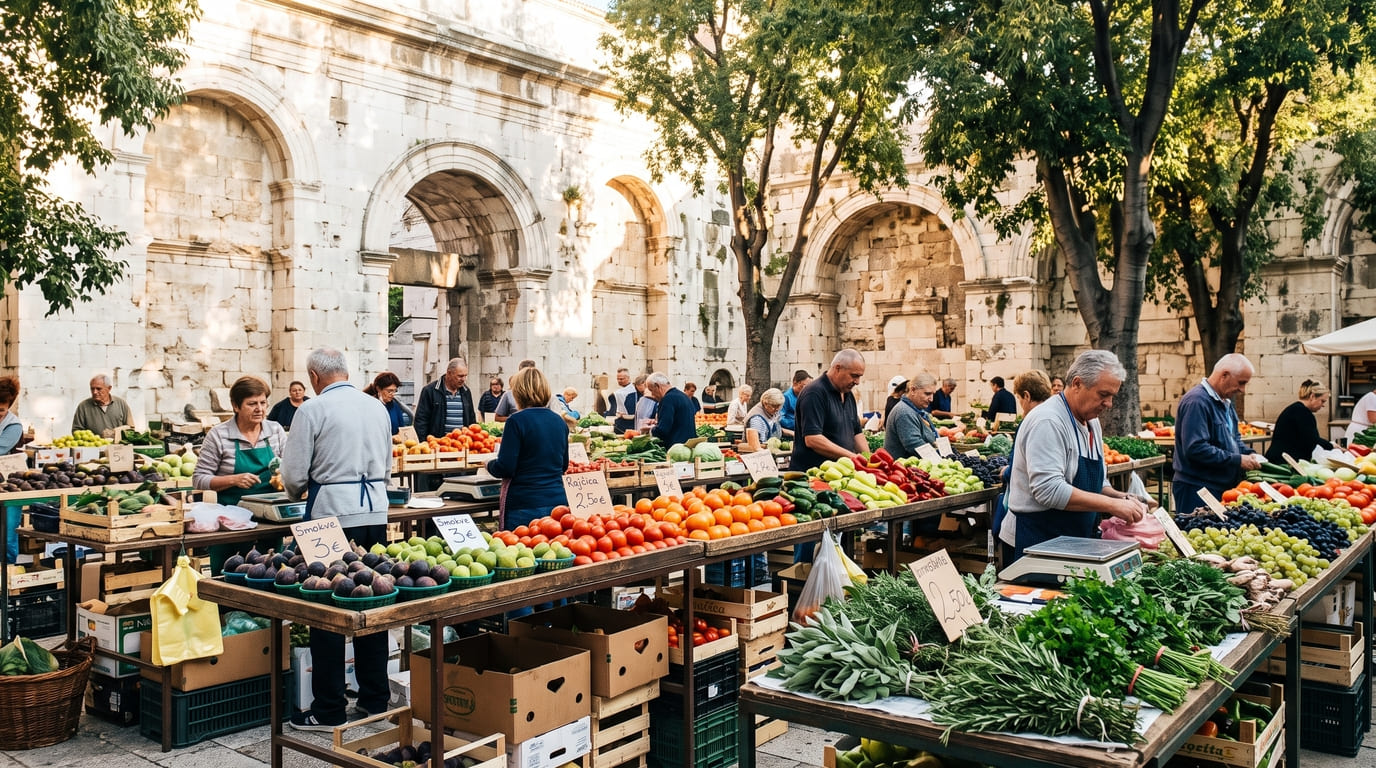
Pazar is Split’s main open-air market and the best place to buy fresh, seasonal produce from Dalmatian farms. Locals come here for their daily shopping, and visitors come for the colours, the smells and the lively bargaining that make it feel like the real heart of the city.
Where Is Pazar and When Is It Open?
Pazar is located along the eastern wall of Diocletian’s Palace, near the Church of St Dominic and the Silver Gate. If you walk out of the palace through the Silver Gate, the stalls start right in front of you.
The market is open every day from early morning until around 2 pm. Some stalls selling clothes and accessories stay open longer, but the produce is at its best before 9 am, when the choice is widest and the day is still cool.
What Can You Buy at Pazar?
Most stalls sell fresh, seasonal fruit and vegetables grown in the Dalmatian hinterland. Between them you will also find:
- Olive oil from local family producers, usually sold in plastic or glass bottles.
- Dried figs and dried fruit, a classic Dalmatian snack.
- Homemade cheese and pršut, the local dry-cured ham.
- Honey, dried herbs and lavender products.
- Homemade wine, rakija and travarica, a herbal brandy popular across Dalmatia.
Closer to the palace walls you will also see stalls with clothes, bags, hats and beach towels. These are useful if you forgot something for the beach, but they are not local products, so do not mistake them for traditional souvenirs.
A Short History of Pazar
Split’s market did not always stand here. According to the Split Tourist Board, it was originally held on today’s Fruit Square, inside the Old Town, but moved to its current location as the city grew and needed more space. The name Pazar itself simply means “market”, and for generations it has been where people from Split meet, chat and buy their food.
Peškarija: Split’s Historic Fish Market
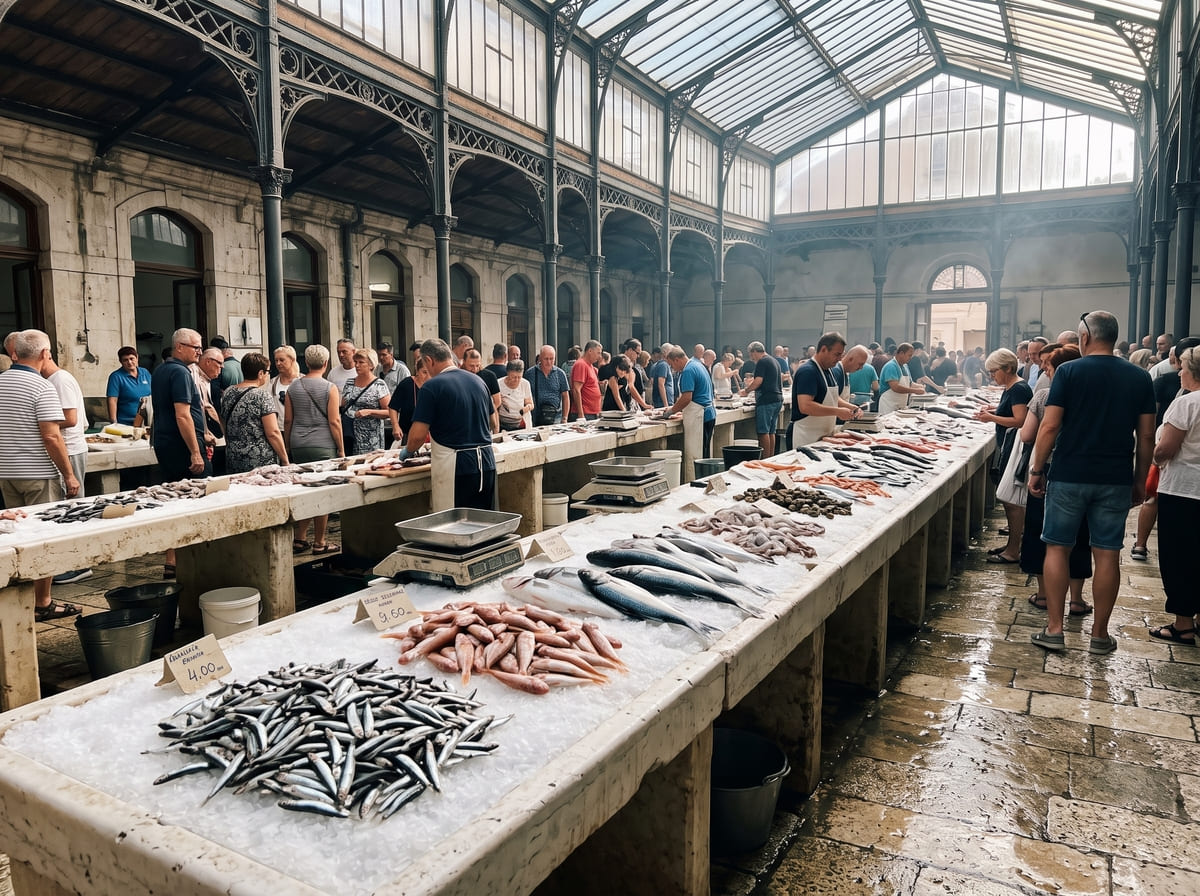
Peškarija is Split’s fish market, where you can see almost everything the Adriatic has to offer, from sardines to lobsters. It is one of the most authentic places in the city, and even a ten-minute walk through it tells you a lot about Dalmatian food culture.
Where Is the Split Fish Market and When Is It Open?
The fish market is located at Obrov 5, just off Marmontova Street, a few minutes’ walk west of Diocletian’s Palace. The building was constructed in 1890 to a design by Ante Bezić, replacing the old wooden stalls where fish had been sold before. Inside, it still has its original stone floor and stone counters, under a glass roof supported by slender cast-iron columns. The building is protected as a cultural heritage site of Croatia.
Peškarija works in the morning, from early hours until around 1 pm. Fishermen and vendors bring the freshest fish first thing, so the earlier you come, the better the choice. On Sundays, public holidays and outside the main season, the offer can be smaller, so plan an early visit.
What Can You Find at Peškarija?
The selection changes daily and depends on the catch, but you can usually find:
- Small blue fish: sardines, anchovies, mackerel and picarel, the base of many traditional Dalmatian dishes.
- Premium white fish: sea bass, dentex, red porgy and scorpionfish.
- Shellfish and crustaceans: mussels, oysters and, on some days, lobster.
If you are staying somewhere with a kitchen, ask the vendor where the fish was caught and whether it is wild or farmed. Fresh fish has clear eyes, firm flesh and a clean smell of the sea. Many vendors will also clean the fish for you.
Why Are There No Flies at the Fish Market?
Locals will tell you that Peškarija has no flies because of the sulphur springs next door. The smell of the sulphur water from the nearby old spa is said to keep insects away, and the Split Tourist Board even links the same springs to the legend of why Emperor Diocletian chose this spot for his palace. Whether it is the sulphur or just good luck, it is one of the city’s favourite stories.
Split Markets at a Glance
| Market | Location | When | Best for |
|---|---|---|---|
| Pazar (green market) | Along the east wall of Diocletian's Palace, by the Silver Gate | Every day, early morning to around 2 pm | Fruit, vegetables, olive oil, figs, cheese, honey, rakija |
| Peškarija (fish market) | Obrov 5, next to Marmontova Street | Mornings, until around 1 pm | Fresh Adriatic fish and shellfish |
| Advent fair | Riva and City Park (Đardin) | Advent season (dates vary each year) | Festive food, mulled wine, gifts and souvenirs |
Authentic Souvenirs to Bring Home From Split
The most authentic souvenirs from Split are local food products and items with a real connection to Dalmatia, such as olive oil, dried figs, prošek, Hvar lavender and Brač stone. Many of them are sold directly at Pazar, while others are easy to find in specialised shops in the Old Town.
If you are wondering what to buy in Croatia that is not a fridge magnet, these are good places to start:
| Souvenir | What it is | Tip |
|---|---|---|
| Olive oil | Extra virgin oil from Dalmatian olives, often from small family groves | Ask the vendor where and when it was pressed |
| Dried figs | A traditional Dalmatian snack, often sold on strings or in bags | Easy to pack and keeps well |
| Prošek | Dalmatian dessert wine made from grapes dried before pressing | Pairs well with dried figs and cheese |
| Travarica | Herbal rakija, a common welcome drink in Dalmatian homes | Check your airline's rules for liquids |
| Hvar lavender | Lavender oil, soaps and sachets from the "island of lavender" | Look for products from Hvar producers |
| Brač stone | Small objects made of the white limestone used to build Diocletian's Palace | A light, lasting reminder of Split |
| Croatian cravat | A tie, the accessory whose name comes from Croatian soldiers | A classic gift for someone at home |
| Licitar heart | Decorated honey-dough heart from northern Croatia | A colourful gift, protected by UNESCO |
Edible Souvenirs From Pazar
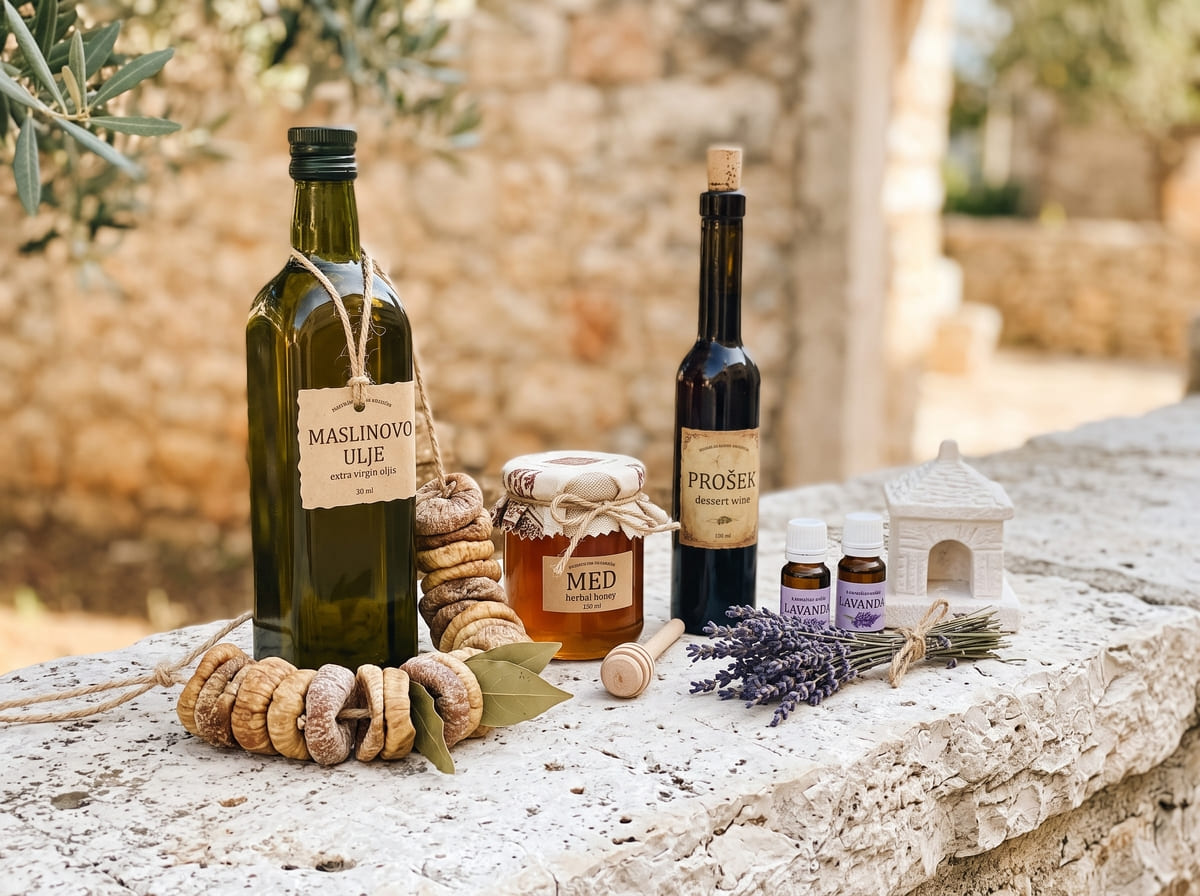
Food is the easiest way to take Dalmatia home. At Pazar, look for local olive oil, dried figs, honey and bottles of travarica. Many visitors also bring home pršut, the Dalmatian dry-cured ham, which is not only dried but also smoked during the curing process. If you buy meat or cheese, check your home country’s rules for bringing food products before you pack them.
For something sweeter, prošek is a traditional Dalmatian dessert wine. The grapes are left to dry before pressing, which concentrates the sugar and gives the wine its rich taste. Our guide to experiencing Split’s gastronomy like a local has more ideas for what to taste while you are in town.
Lavender, Stone and Other Dalmatian Classics
Hvar is often called the “island of lavender”, and its lavender has been grown for aromatic oils and soaps for generations. Small bottles of oil and fabric sachets are light and smell like a Dalmatian summer. If you want to see the fields yourself, Hvar is one of the best island hopping routes from Split.
The white limestone from the island of Brač has an even closer link to Split. Diocletian’s Palace was largely built with limestone quarried on Brač, so a small object made of Brač stone is a souvenir with more than 1,700 years of history behind it.
The Croatian Cravat and Licitar Hearts
Few people know that the tie comes from Croatia. In the 17th century, Croatian soldiers in France wore a distinctive scarf around their necks, and the French word “cravate” comes from the word for “Croat”. Croatia celebrates Cravat Day every year on 18 October, and you will find tie shops in and around the Old Town.
Licitar hearts are bright red, decorated hearts made of sweet honey dough. They come from northern Croatia rather than Dalmatia, but they are one of the country’s best-known symbols, and the craft of making them was added to the UNESCO list of Intangible Cultural Heritage in 2010.
How to Recognise Authentic Croatian Products
The simplest way to find authentic Croatian souvenirs is to buy directly from local producers and to look for official quality labels. A few tips:
- Look for the labels “Izvorno hrvatsko” (Croatian Creation) and “Hrvatska kvaliteta” (Croatian Quality), both awarded by the Croatian Chamber of Economy.
- Ask the vendor where the product comes from. At Pazar, many sellers make or grow what they sell.
- Avoid generic items such as mass-produced clothes, sunglasses and plastic souvenirs, which are rarely made in Croatia.
- Taste first when you can. Vendors are often happy to let you try cheese, figs or honey before you buy.
Is There a Christmas Market in Split?
Yes. During Advent, Split’s main Christmas market is held on the Riva, with wooden cottages selling food, drinks and souvenirs. A second, quieter Advent location is set up in City Park, known as Đardin, along Kralja Tomislava Street.
The fair usually runs through December and into January, with concerts and festive events across the city, but the exact dates change every year. Check the Split Tourist Board’s Advent guide before your trip. If you are planning a winter visit, our article on Split in winter and our guide to the Split Riva will help you plan the rest of your stay.
Tips for Shopping at Split’s Markets
Go early, bring cash and take your time. A few practical tips will make your visit easier:
- Arrive before 9 am for the best choice of produce and fish, especially in summer.
- Bring euros in small notes and coins. Many stalls accept cash only and may not have change for large notes.
- Visit the fish market late in the morning for lower prices. Around noon, some vendors reduce prices on what is left.
- Bring a reusable bag for fruit and vegetables.
- Be patient with language. Some older vendors speak little English, but pointing and a smile always work.
- Combine the markets with sightseeing. Both are close to the main sights, so you can easily continue to the palace or the Riva.
A Morning Market Walk Through Split
You can see both markets and the heart of the Old Town in a relaxed two-hour morning walk. One easy route:
- Start at Pazar early in the morning and walk through the stalls towards the Silver Gate.
- Enter Diocletian’s Palace through the Silver Gate and continue to the Peristyle.
- Walk west through the Old Town to Pjaca, the People’s Square.
- Continue to Marmontova Street and turn to Peškarija to see the morning catch.
- Finish with a coffee on the Riva, just a few steps away.
If you have more time, our complete visitor guide to Diocletian’s Palace shows what to see along the way.
Frequently asked questions (FAQ)
The green market in Split is called Pazar. It is an open-air market along the eastern wall of Diocletian’s Palace, near the Silver Gate, where locals buy fruit, vegetables and other local products every day.
Pazar opens early in the morning, every day, and most produce stalls close around 2 pm. The best time to visit is before 9 am, when the choice is widest and the temperatures are lower.
The fish market, Peškarija, is at Obrov 5, next to Marmontova Street and a few minutes’ walk west of Diocletian’s Palace. It is open in the morning, usually until around 1 pm.
According to local tradition, the smell of sulphur water from the nearby springs keeps flies away from Peškarija. It is one of the best-known stories about the market.
The best souvenirs from Split are local products such as olive oil, dried figs, honey, travarica, prošek and Hvar lavender. Brač stone objects and the Croatian cravat are good non-food options.
Many stalls at Pazar and Peškarija accept cash only. Bring euros in small notes and coins, as vendors may not have change for large notes.
Yes. During Advent, a Christmas fair is held on the Riva, with a second location in City Park (Đardin). Dates change every year, so check the Split Tourist Board website before your visit.
Where to stay in Split?


CONCLUSION
Split’s markets are where the city shows its everyday side: vendors calling out prices, locals choosing their tomatoes one by one and vendors laying out the morning catch. Spend an hour at Pazar and Peškarija, and you will leave with more than a bag of figs.
Start your morning at the market, continue through the Old Town of Split, and you will experience the city the way locals do.
Related blogs
Local Markets in Split: From Fresh Produce to Authentic Souvenirs
Discover Pazar, the green market by Diocletian's Palace, and Peškarija, Split's historic fish market. Find out when to go, what to buy, which souvenirs are authentic and tips for your market visit.
Exploring Ancient Salona: Roman Ruins Near Split
Explore ancient Salona, the Roman capital of Dalmatia just 6 km from Split. Discover the amphitheatre, Manastirine and Porta Caesarea, and find out how to get there, ticket prices and tips for your visit.

Split to Plitvice Lakes: How to Get There and Plan the Perfect Day Trip
Plan the perfect Split to Plitvice Lakes day trip with this practical guide. Compare driving, bus and organised tour options, travel times, entrances, tickets and useful tips for visiting the park.
Best Time to Visit Split, Croatia: A Month-by-Month Guide
Discover the best time to visit Split with this month-by-month guide. Compare weather, sea temperatures, beaches, sightseeing, festivals and seasonal activities to choose the ideal time for your trip.