
Table of content
What Is Salona and Why Is It Important?
How Is Salona Connected to Diocletian and Split?
Why Was Salona Abandoned?
Where Is Salona and How Do You Get There From Split?
What Can You See at Salona Today?
The Salona Amphitheatre
Manastirine and the Tusculum Museum
The Episcopal Centre and Basilica Urbana
The Forum, Theatre and Porta Caesarea
The Five Bridges, Kapljuč and Marusinac
Salona at a Glance
How Much Are Salona Tickets and What Are the Opening Hours?
How Long Do You Need to Visit Salona?
What Should You Know Before Visiting Salona?
When Is the Best Time to Visit Salona?
Can You Combine Salona With Other Places Near Split?
Frequently Asked Questions
Where to stay in Split
Conclusion
Related blogs
Salona was the capital of the Roman province of Dalmatia and one of the largest cities on the eastern Adriatic. Today its ruins lie in the town of Solin, about 6 km from Split, and form the largest archaeological park in Croatia.
For anyone interested in history, Salona completes the story that begins at Diocletian’s Palace. The emperor who built the palace is recorded as a native of Salona, and centuries later the people of Salona found refuge inside the palace walls and turned it into the city of Split.
This guide explains what Salona is, how to get there from Split, what to see at the Salona archaeological site, how much tickets cost and how to plan a relaxed half-day visit.
Key takeaways
- Salona is around 6 km from Split, in the town of Solin, and is easy to reach by car, taxi or local bus line 1.
- The main sights are the Salona amphitheatre, the early Christian complex of Manastirine, the episcopal centre and the city walls with Porta Caesarea.
- An adult ticket costs 8 €, and a combined 10 € ticket also covers the Archaeological Museum in Split.
- Plan 1.5 to 2.5 hours on site and visit in the morning or late afternoon, as there is little shade.
What Is Salona and Why Is It Important?
Ancient Salona was the political, economic and religious centre of Roman Dalmatia. At its peak it had around 60,000 inhabitants, and more recent research suggests the population may have reached at least 80,000.
The settlement began in the 3rd century BC, in an area inhabited by the Illyrian Delmatae and close to the Greek colonies of Tragurion (Trogir) and Epetion (Stobreč). After the Roman civil wars under Julius Caesar, it became a Roman colony with the full name Martia Iulia Valeria Salona Felix.
Salona later became the capital of the province of Dalmatia. Between 476 and 480 AD it was also the last residence of Emperor Julius Nepos, which briefly made it an unofficial capital of the Western Roman Empire.
Together with the other historical sites in and around Split, Salona shows how the region developed from an Illyrian and Greek settlement into a major Roman city and, later, into medieval Split.
How Is Salona Connected to Diocletian and Split?
Salona is recorded as the birthplace of Emperor Diocletian, who later built his retirement palace a few kilometres away, on the coast where Split stands today. The palace’s northern entrance, the Golden Gate, faced the road that led to Salona.
Salona is also closely linked to Split’s patron saint. Bishop Domnius of Salona was executed on 10 April 304, during Diocletian’s persecution of Christians, and buried at Manastirine. His name lives on in the Cathedral of Saint Domnius, built inside the emperor’s former mausoleum.
Why Was Salona Abandoned?
Salona was abandoned after Avar and Slavic raids in the early 7th century. The last dated inscription found in the ruins comes from 12 May 612, and the fall of the city is traditionally dated to 614, although historians still discuss the exact year.
Many of the refugees settled inside Diocletian’s Palace. Their homes, churches and streets gradually turned the imperial residence into a town, which is why the Old Town of Split still has Roman walls, medieval houses and modern life side by side.
Where Is Salona and How Do You Get There From Split?
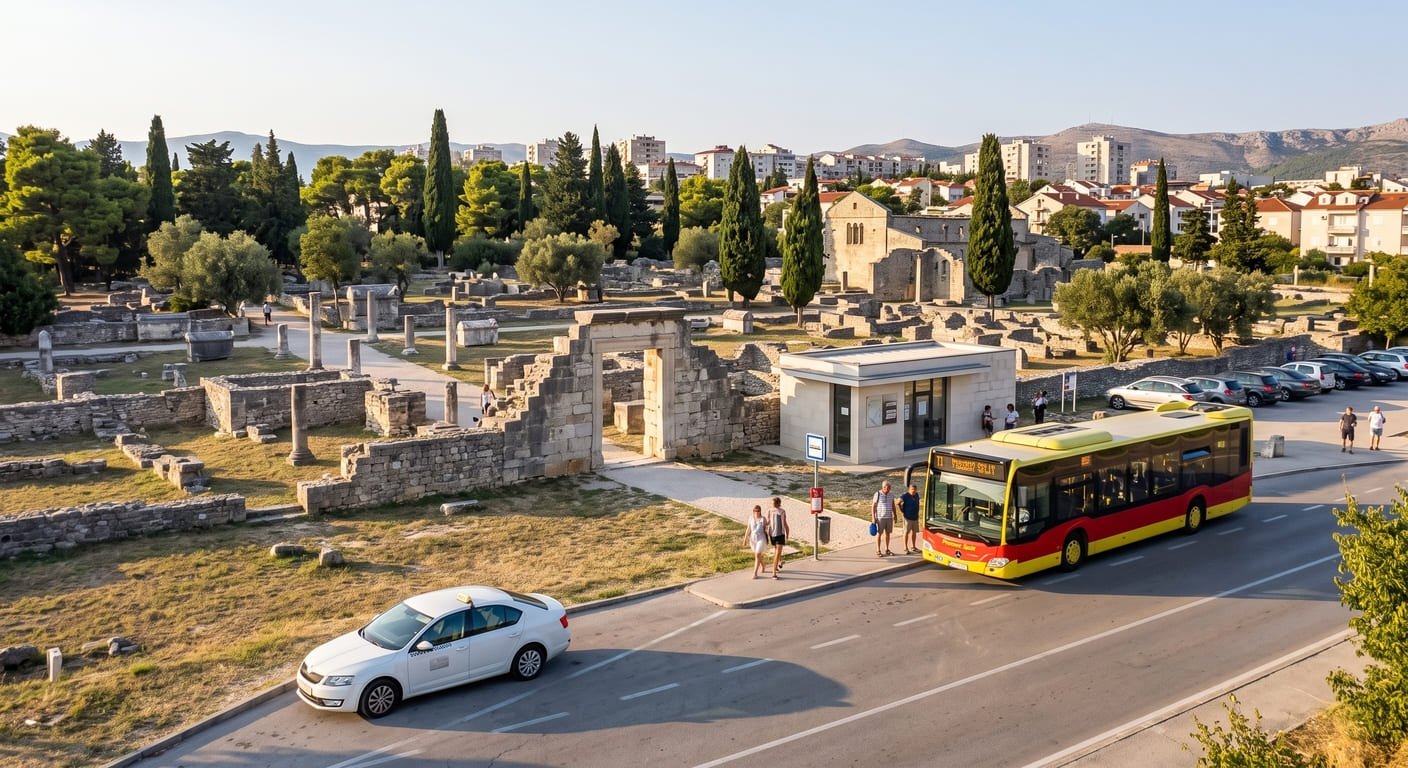
Salona is located in Solin, around 6 km from Split. The site is close enough for a half-day trip, and you can reach it in several ways:
- By local bus: Bus line 1 runs from Split towards Solin and stops near the site. Journey times depend on traffic, so allow around 30 minutes. Check the current route and timetable on the Promet Split website.
- By car: The drive from central Split usually takes around 15 minutes, depending on traffic. There is free parking next to the site.
- By taxi: A taxi is the most convenient option if you want to save time, especially in the summer heat.
- With an organised tour: Some tours combine Salona with nearby Klis Fortress or Trogir, which is useful if you prefer a guide.
The site has several entrances. The main entrance at Tusculum, next to Manastirine, is the best starting point, as you can buy tickets there and follow the site from its best-preserved early Christian complex.
What Can You See at Salona Today?
The most important sights at the Salona ruins are the amphitheatre, Manastirine with Tusculum, the episcopal centre, the forum and theatre, the city gate Porta Caesarea, and the early Christian cemeteries outside the walls. Many of them are spread over a large, open area, so comfortable shoes are a must.
The Salona Amphitheatre
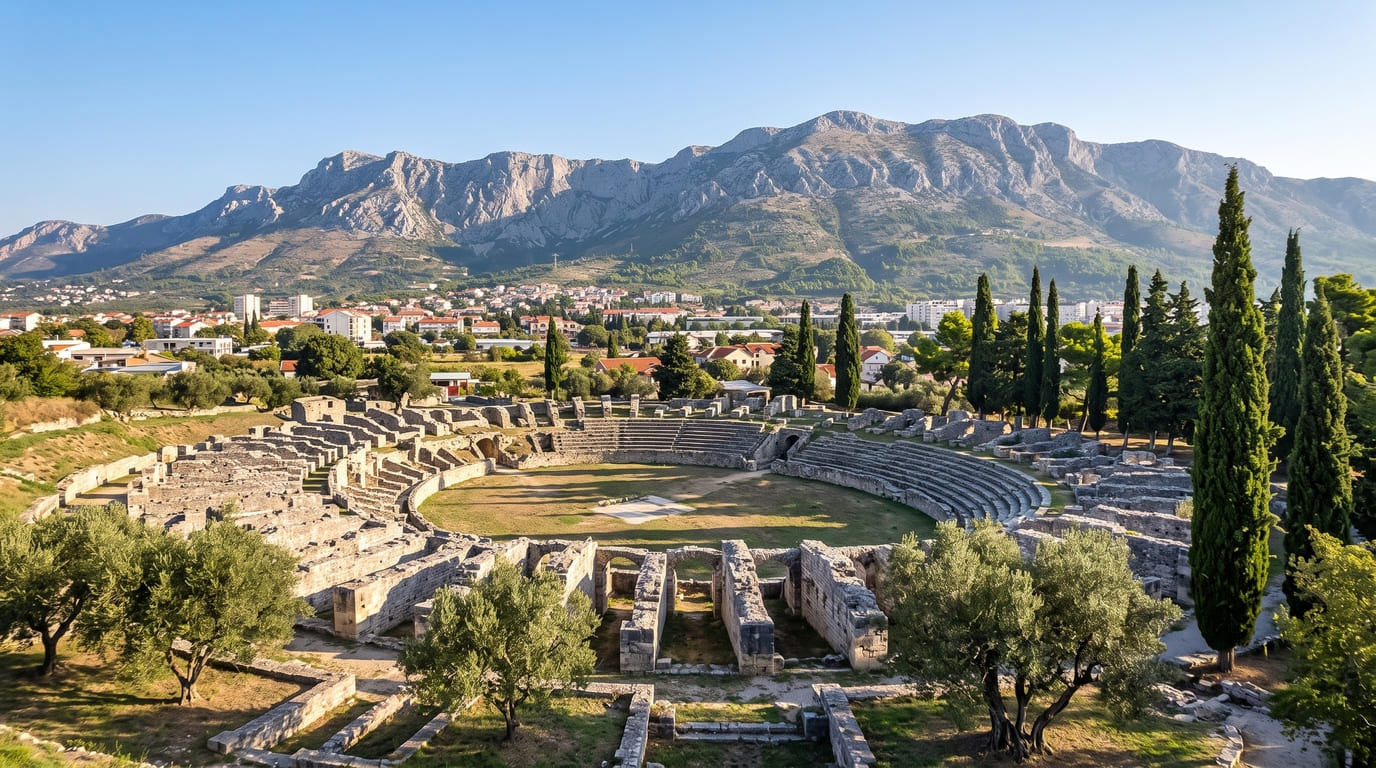
The Salona amphitheatre is the largest monument on the site. It measures 125 x 100 m, with an arena of 65 x 40 m, and could hold about 17,000 spectators.
The amphitheatre stands in the north-western corner of the ancient city. Even though only the lower parts of the walls and seating survive, you can easily picture the scale of the games held here.
Manastirine and the Tusculum Museum
Manastirine is the most important early Christian complex in Salona. It includes the ruins of a basilica and a cemetery outside the city walls, where Bishop Domnius was buried.
Next to the ruins stands Tusculum, a house built by archaeologist Frane Bulić for the First Congress of Early Christian Archaeology, held in Solin and Split in 1894. Bulić named it after Cicero’s villa and built ancient stone fragments into its walls.
Today the ground floor of Tusculum houses a small memorial collection dedicated to Bulić, while archaeologists still use the upper floor. Solin Tourist Board notes that Bulić’s grave lies on the western side of Manastirine, under a cypress tree.
The Episcopal Centre and Basilica Urbana
The episcopal centre was the heart of Christian Salona. Built in the 5th century, it includes double basilicas, a baptistery and the bishop’s palace. The Basilica Urbana, part of this complex, is described by the Archaeological Museum in Split as the largest basilica in Dalmatia.
The Forum, Theatre and Porta Caesarea
These remains show what public life looked like in Roman Salona:
- Forum: the centre of public and political life, measuring 45 x 70 m.
- Theatre: built in the 1st century and measuring 65 x 58 m.
- Porta Caesarea: the well-preserved city gate from the time of Emperor Augustus, flanked by two octagonal towers. Look for the grooves left by cart wheels in the stone.
The Five Bridges, Kapljuč and Marusinac
Some of Salona’s most interesting monuments lie a short walk from the main area:
- Five Bridges: a 1st-century BC crossing over the Jadro river, with five arches on massive pillars.
- Kapljuč: the oldest burial basilica in Salona, built in the mid-4th century above the graves of early Christian martyrs.
- Marusinac: a complex with a mausoleum and two basilicas dedicated to the martyr Anastasia.
Salona at a Glance
| Monument | What it is | Period | Why visit |
|---|---|---|---|
| Amphitheatre | Arena for about 17,000 spectators | Roman imperial period | The largest and most impressive monument on the site |
| Manastirine | Early Christian basilica and cemetery | Early Christian period | Burial place of Saint Domnius |
| Tusculum | Frane Bulić's house and memorial collection | Built for the 1894 congress | Main entrance, tickets and site history |
| Episcopal centre | Double basilicas, baptistery, bishop's palace | 5th century | Includes the largest basilica in Dalmatia |
| Forum and theatre | Centre of public life | 1st century (theatre) | Shows the layout of the Roman city |
| Porta Caesarea | City gate with two octagonal towers | Time of Augustus | Cart-wheel grooves in the stone |
| Five Bridges | Bridge over the Jadro river | 1st century BC | Rare Roman bridge remains |
| Kapljuč | Burial basilica of the martyrs | Mid-4th century | Oldest burial basilica in Salona |
How Much Are Salona Tickets and What Are the Opening Hours?
An adult ticket for the Salona archaeological site costs 8 €, and a ticket for children or students costs 4 €. Children under 6 enter free. The site is managed by the Archaeological Museum in Split, which also offers combined and family tickets.
| Ticket | Price |
|---|---|
| Salona, adults | 8 € |
| Salona, children or students | 4 € (free under 6) |
| Combined ticket Salona + Archaeological Museum in Split, adults (valid 7 days) | 10 € |
| Combined ticket, children (valid 7 days) | 5 € |
| Family ticket (max. 2 adults with minor children) | 15 € |
Tickets can also be bought online through the museum’s official ticket page. The combined ticket is good value if you also plan to see the museum’s collection in Split, which is also a good option for a rainy day in Split.
According to the Archaeological Museum in Split, the Salona site is open:
- 1 June to 30 September: every day, 9:00 to 20:00
- 1 October to 31 May: every day, 9:00 to 18:00
Opening hours can change on public holidays, so check the museum’s opening hours before your visit.
How Long Do You Need to Visit Salona?
Most visitors need 1.5 to 2.5 hours to see the main parts of Salona. With travel from Split, a visit fits easily into a morning or an afternoon.
One practical route through the site:
- Start at the main entrance, buy tickets at Tusculum and explore Manastirine.
- Walk towards the episcopal centre and the Basilica Urbana.
- Continue to Porta Caesarea and the city walls.
- See the forum and the theatre.
- Finish at the amphitheatre in the north-western part of the site.
What Should You Know Before Visiting Salona?
Salona is an open-air site with uneven ground and very little shade, so a little preparation makes the visit much more pleasant:
- Wear comfortable walking shoes, as many paths are gravel, grass or uneven stone.
- Bring water, a hat and sunscreen. There are no refreshments on site.
- In summer, visit early in the morning or in the late afternoon to avoid the midday heat.
- Accessibility is limited because of the uneven terrain.
- Allow time for walking between monuments, as the site covers a large area.
When Is the Best Time to Visit Salona?
Spring and autumn are the best seasons for visiting Salona. Temperatures are comfortable for walking, and the site is usually quiet. Our month-by-month guide to the best time to visit Split can help you choose the right period for your trip.
Summer visits are possible, but go early or late in the day. Winter is also a good choice for history lovers, as Salona pairs well with other cultural highlights of Split in winter.
Can You Combine Salona With Other Places Near Split?
Yes, Salona combines easily with Klis Fortress, which is only a short drive further inland. The medieval fortress offers wide views over Solin and Split, and fans will recognise it as Meereen from Game of Thrones.
Other good combinations include:
- Archaeological Museum in Split, where many finds from Salona are displayed (included in the combined ticket).
- The Jadro river in Solin, pleasant for a short walk after the ruins.
- Other day trips from Split, such as the places in our guide to must-visit hidden gems near Split.
FREQUENTLY ASKED QUESTIONS
Yes. Salona is the largest archaeological park in Croatia and the former capital of Roman Dalmatia. It is a rewarding half-day trip from Split for anyone interested in Roman history, early Christianity or the origins of Split.
Salona is around 6 km from Split, in the town of Solin. The drive usually takes around 15 minutes, while the local bus takes about 30 minutes, depending on traffic.
Local bus line 1 runs from Split towards Solin and stops near the Salona archaeological site. Check the current timetable on the Promet Split website before travelling.
An adult ticket for Salona costs 8 € and a ticket for children or students costs 4 €. A combined ticket for Salona and the Archaeological Museum in Split costs 10 € for adults and is valid for 7 days.
Salona is known as the capital of the Roman province of Dalmatia, the recorded birthplace of Emperor Diocletian and an important early Christian centre. Its best-known monuments are the amphitheatre, Manastirine and the episcopal centre.
Salona was abandoned after Avar and Slavic raids in the early 7th century, traditionally dated to 614. Many residents fled to Diocletian’s Palace, where they laid the foundations of medieval Split.
Salona suits children who enjoy walking and exploring open spaces. Children under 6 enter free, but the terrain is uneven and there is little shade, so plan a shorter visit on hot days and bring water.
Where to stay in Split?


CONCLUSION
Salona is where the story of Split really begins. Walking among its walls, basilicas and amphitheatre helps you understand why Diocletian chose this coast, and how the people of Salona later turned his palace into a living city.
Combine a morning in Salona with an afternoon in the Old Town, and follow the same history from its Roman roots to the sights inside Diocletian’s Palace.
Related blogs

Valentine’s Day in Split: Romantic getaway for couples
Make your Valentine's Day unforgettable in the heart of Dalmatia. Split offers a unique blend of Roman history and Mediterranean charm. From sunset views at Marjan Hill to intimate dinners within palace walls, every moment is a chance to connect deeply with your partner.

Split Riva – what to know about the city’s most lively promenade
Split Riva is much more than just a walkway along the sea; it is the symbolic "living room" of every citizen of Split. For centuries, this promenade has been the stage for the [...]

What to do in Split on a rainy day: indoor activities and hidden spots
What to do in Split on a rainy day: discover the best indoor activities, from atmospheric cafés and local museums to wellness centres, galleries and hidden corners of the old town. Even when it rains, Split offers plenty of warm, inspiring and relaxing experiences.

Top Instagrammable Spots in Split: Capture the City Through the Lens
Split is full of stunning locations perfect for Instagram - from the ancient Diocletian's Palace to breathtaking Marjan views. This guide revelas the best photo spots around the city to help you capture unforgettable moments and share them with the world.