
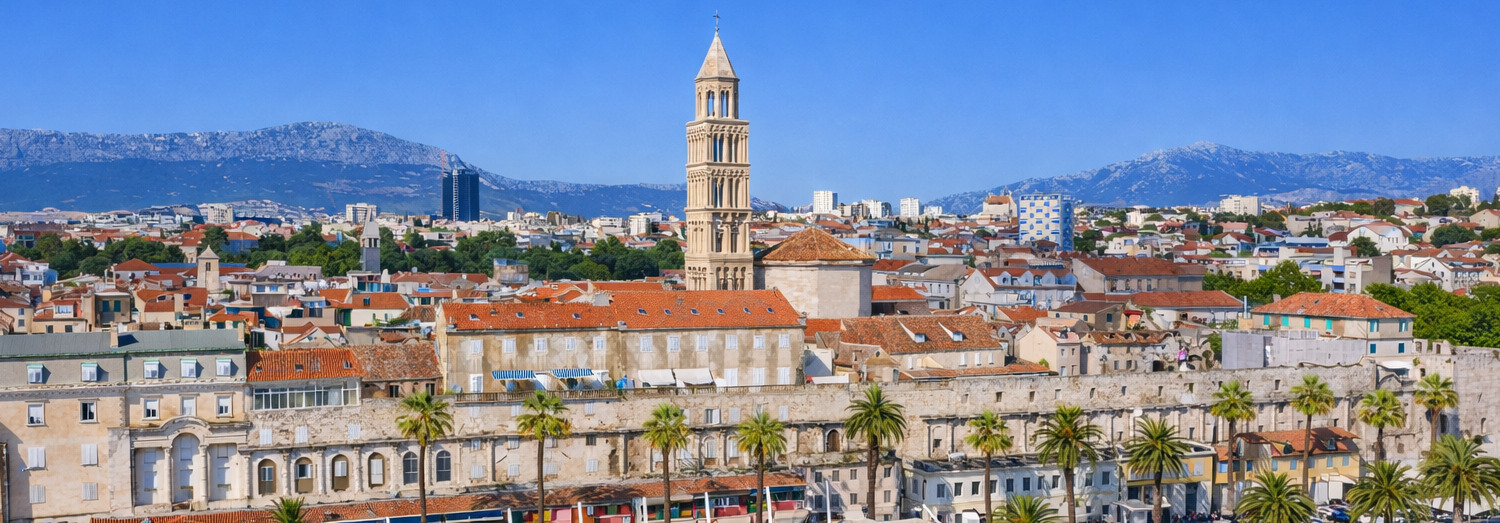
Stepping into Diocletian’s Palace isn’t like visiting a typical museum; it’s like entering a living, breathing time machine. Built at the turn of the 4th century for the Roman Emperor Diocletian, this UNESCO World Heritage site is the heart and soul of Split.
While many ancient ruins are cordoned off, here, people still live, drink coffee, and run shops within the 1,700-year-old walls. If you are staying at Seagull Accommodation, you are just a few steps away from this Roman marvel.
Here is your complete 2026 guide on what to see and visit inside the palace.
The Peristyle: The Palace’s Heart
The Peristyle is the central square of the palace and arguably one of the most beautiful Roman courts in existence. Surrounded by towering columns and overlooked by the Cathedral’s bell tower, this is where the Emperor would appear to his subjects.
- Visitor Tip: In the summer of 2026, don’t miss the “Changing of the Guard” ceremony at noon. Also, grab a cushion on the steps of Luxor café in the evening to enjoy live music under the stars.
Cathedral of St. Domnius & The Bell Tower
Originally built as Diocletian’s mausoleum, this is one of the oldest Catholic cathedrals in the world still in use. It’s a fascinating irony that the emperor who persecuted Christians now rests in a building dedicated to their patron saint.
- The Climb: For the best 360-degree view of Split in 2026, climb the Romanesque Bell Tower. It’s a steep climb, but the view of the harbor and the Marjan hill is unbeatable.

Diocletian’s Cellars (The Substructures)
The palace substructures are among the best-preserved ancient complexes of their kind in the world. They mirror the layout of the imperial residence above (which is now mostly gone), giving you a sense of the palace’s true scale and architectural grandeur.
Fun Fact about the Cellars:
-
- Fans of Game of Thrones will recognize these cellars as the iconic location where Daenerys kept her dragons.
- Today, the central hall serves as a vibrant passage filled with local artisans selling handcrafted jewelry and unique souvenirs.
- Walking through these halls allows you to experience the original Roman cooling system, as the temperature remains naturally chilly even in mid-August.
The Vestibule: A Gateway to the Imperial Past
Located just south of the Peristyle, this circular rotunda was the formal entrance to the imperial apartments. The dome once featured glittering mosaics, but today it is open to the sky, creating incredible acoustics that draw visitors from all over the world.
Don’t Miss:
- You can often find a Klapa group (traditional Dalmatian a cappella singers) performing here.
- Their voices resonating through the stone walls is a quintessential Split experience that perfectly showcases the city’s living heritage.
The Temple of Jupiter: A Roman Gem
Tucked away in a narrow alley, this small but perfectly preserved temple was dedicated to the Roman god Jupiter. Its coffered ceiling is one of the most remarkable examples of Roman stonework, featuring 64 unique stone panels with different floral and human motifs. During the early Middle Ages, the temple was converted into the Baptistery of St. John, which helped preserve its structure through the centuries.
What to look for at the Temple:
- Look out for the black headless sphinx at the entrance—it was brought all the way from Egypt by the Emperor himself to guard the sacred space.
- Inside, you can see a modern bronze statue of St. John the Baptist, created by the famous Croatian sculptor Ivan Meštrović.
- The medieval baptismal font inside features an 11th-century carving of a Croatian king, one of the earliest representations of a European ruler in stone.
The Four Gates: Entering the Roman Fortress
Diocletian’s Palace was originally designed as a military fortress, featuring four main entrances named after metals. These gates were strategically placed at the center of each wall, connected by two main streets (Cardo and Decumanus) that still intersect at the Peristyle today. Walking through these gates is the most authentic way to experience the grandeur of Roman urban planning.
The distinctive characteristics of the Gates:
- The Golden Gate (North): This was the most ornate entrance, strictly reserved for the Emperor and his family as they arrived from Salona.
- The Silver Gate (East): Once closed for centuries, it now leads directly to the vibrant Green Market (Pazar), blending ancient stone with local daily life.
- The Iron Gate (West): The only gate that has been continuously open since Roman times. It features a unique 11th-century 24-hour clock and leads to the medieval Pjaca square.
- The Bronze Gate (South): Historically the direct entrance from the sea. Today, it serves as the main link between the Riva promenade and the Palace Cellars.
Local Tip: When entering through the Golden Gate, look up at the small niches; they once held statues of the four Tetrarchs who ruled the Roman Empire alongside Diocletian.
Gregory of Nin (Grgur Ninski): A Touch of Good Luck
Technically located just outside the Golden Gate, this massive bronze statue of a 10th-century bishop is one of Split’s most iconic landmarks. Created by the world-renowned Croatian sculptor Ivan Meštrović, the statue is a masterpiece of modern expressionism, standing tall as a symbol of Croatian pride and the struggle for the use of the national language in liturgy.
Why you must visit Gregory of Nin:
- Tradition says that rubbing the statue’s big toe brings good luck and ensures you will one day return to Split.
- In 2026, it remains the most famous and photographed “toe” in the entire Mediterranean!
- The sheer size and power of the sculpture are best appreciated by standing right at its base, looking up at the intricate folds of the bishop’s robe.
Local Tip: After making your wish, take a moment to enjoy the Strossmayer Park (Đardin) located right behind the statue—it’s a beautiful green oasis perfect for a short break after exploring the Palace walls.

Frequently Asked Questions (FAQ)
No, the Palace itself is a living part of the city. There is no entrance fee or main gate to enter the neighborhood. You can walk through the ancient streets and squares 24/7 for free. However, specific sites within the Palace (the Cathedral, the Bell Tower, the Cellars, and the Temple of Jupiter) do require tickets.
To walk through the main squares and see the highlights, 2 to 3 hours is usually enough. However, if you want to climb the Bell Tower, explore the Cellars in detail, and enjoy a coffee at the Peristyle, we recommend dedicated a full morning or afternoon to truly soak in the atmosphere.
Because the Palace is over 1,700 years old, it features uneven Roman paving stones and many narrow stairs. While the main squares like the Peristyle and the central hall of the Cellars are accessible, climbing the Bell Tower or reaching certain hidden alleys can be challenging for those with limited mobility.
Yes! The most famous location is the Diocletian’s Cellars, which served as the dragon’s lair. Many of the narrow streets (specifically Papalićeva Street) were also used for filming scenes of the Meereen slave rebellion.
In 2026, Split remains a popular destination. To beat the heat and the crowds, the best time to explore is early morning (before 9:00 AM) or late evening. The Palace is especially magical at night when the Roman stone is illuminated and the crowds on the Peristyle thin out.
Staying just outside the Palace walls is often the best choice. It allows you to be only a 2-minute walk from all the historic sites while avoiding the noise of the late-night bars inside the walls. Seagull Accommodation offers the perfect balance of proximity and peace for your 2026 visit.
Related blogs

Hidden Churches and Chapels of Split Old Town You Shouldn’t Miss
Exploring Split Old Town often feels like walking through an open-air museum — but beyond the famous landmarks, there’s a quieter, more intimate side waiting to be discovered. Hidden between ancient stone streets [...]

What to See and Visit Inside Diocletian’s Palace in Split (Complete 2026 Visitor Guide)
Stepping into Diocletian’s Palace isn’t like visiting a typical museum; it’s like entering a living, breathing time machine. Built at the turn of the 4th century for the Roman Emperor Diocletian, this UNESCO [...]

Valentine’s Day in Split: Romantic getaway for couples
Make your Valentine's Day unforgettable in the heart of Dalmatia. Split offers a unique blend of Roman history and Mediterranean charm. From sunset views at Marjan Hill to intimate dinners within palace walls, every moment is a chance to connect deeply with your partner.

Split Riva – what to know about the city’s most lively promenade
Split Riva is much more than just a walkway along the sea; it is the symbolic "living room" of every citizen of Split. For centuries, this promenade has been the stage for the [...]