
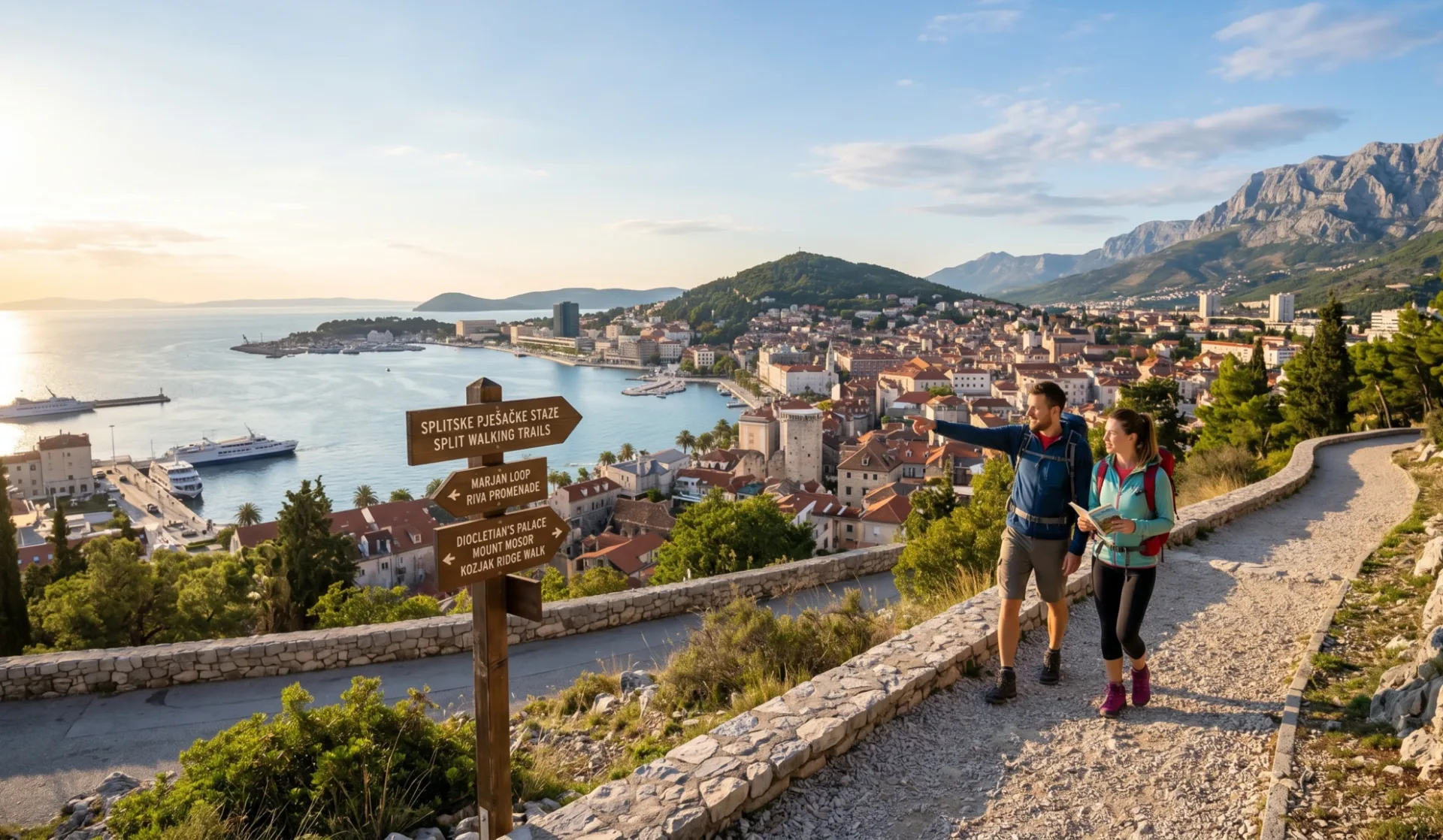
Table of content
1. Marjan Hill Loop – Best for Panoramic Views With Minimal Effort
2. Diocletian’s Palace & Old Town Historical Walk – Best for History
3. Mount Mosor – Best for Serious Mountain Hikers
4. Mount Kozjak Ridge Walk – Best for Ridge Walking Without Technical Difficulty
5. COASTAL PROMENADE – Riva to Kasjuni Beach – Best for a Relaxed Evening Walk
TRAIL COMPARISON AT A GLANCE
FREQUENTLY ASKED QUESTIONS
Where to stay in Split?
CONCLUSION
Related blogs
Split isn’t just a ferry hub between islands – it’s one of the most walkable cities on the Adriatic, with trail options ranging from ancient Roman streets to exposed mountain ridges.
We evaluated routes across five categories – urban heritage, coastal, forest park, and two mountain options – weighing trail conditions, accessibility from the city centre, elevation gain, and what you actually see when you get there. This guide covers the five trails worth your time, whether you have two hours or a full day.
Key Takeways
- All five trails on this list are accessible from the city centre by foot or local bus.
- Spring (April–May) and autumn (September–October) are the best months for mountain routes; the coastal and urban trails are year-round.
- Marjan Hill’s Telegrin summit at 178 m offers the best panoramic view of the Adriatic islands without a challenging climb.
1. Marjan Hill Loop – Best for Panoramic Views With Minimal Effort
Marjan Hill is the single best walk in Split if you want big views without big effort. Declared a protected forest park in 1964, the 3+ km peninsula juts west from the city and its highest point – Telegrin summit at 178 m, built on the site of a Napoleonic-era telegraph station – puts Hvar, Brač, and Šolta islands in one frame with the Dinaric Alps behind you.
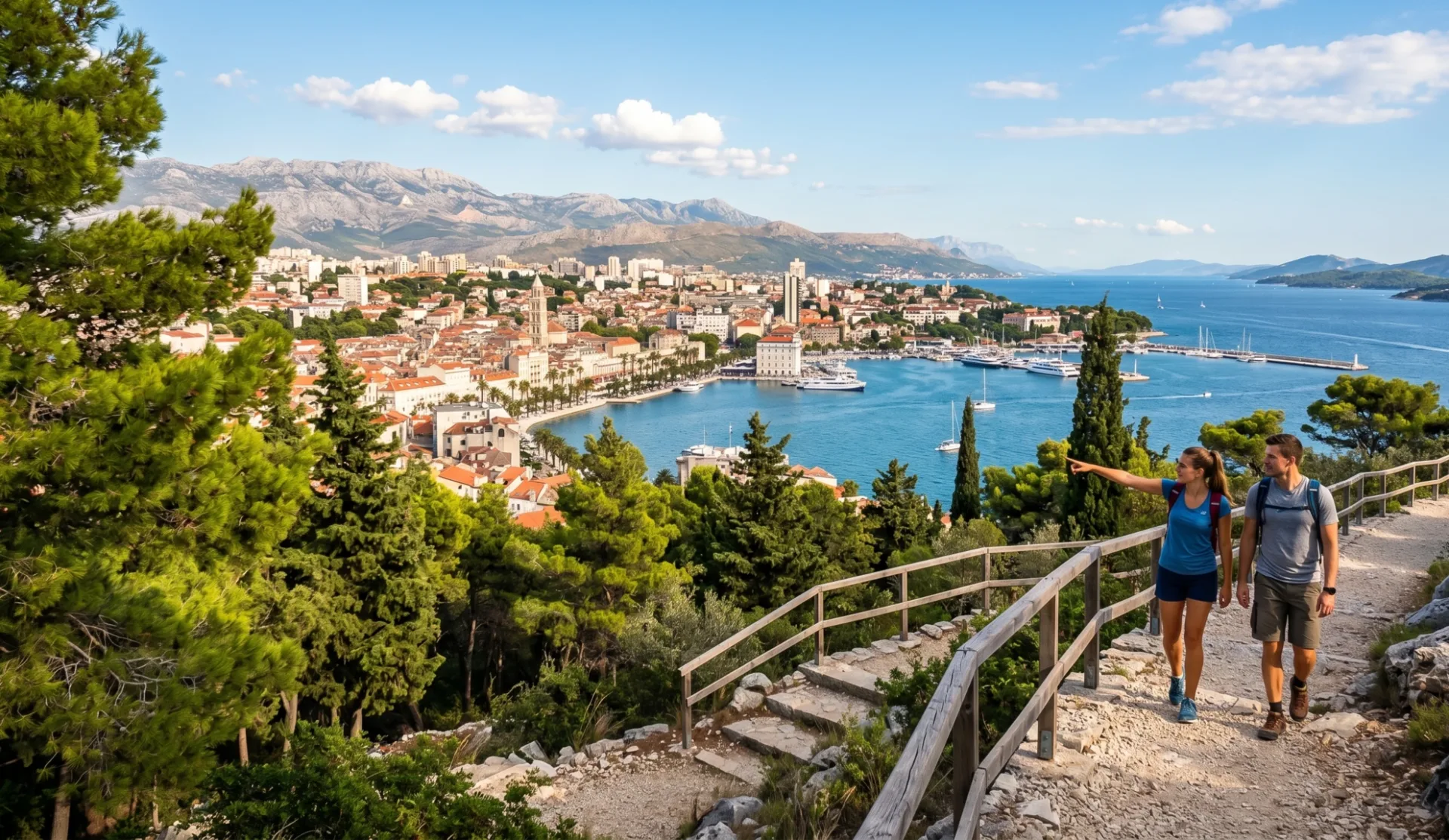
Distance: 8.2 km full loop
Elevation gain: 190 m
Difficulty: Easy to moderate
Duration: 2 to 2.5 hours
Trailhead: Lučica cove car park, western Split (walkable from the old town in 20 minutes)
Why it earns the top spot: Nowhere else in Split do you get a 360-degree panorama for under 200 m of climbing. The loop passes two rock-carved chapels (St. Nikola and St. Jerome), the Stari Zidine – one of the oldest Sephardic Jewish cemeteries in Europe – and the first viewpoint (Prva točka) at roughly 120 m before reaching Telegrin. A 19-metre observation tower near the 148 m secondary peak was recently added and is free to climb.
Best for: Families, first-time visitors, sunset walks, anyone who wants views without a mountain.
Access cost: Free
2. Diocletian’s Palace & Old Town Historical Walk – Best for History
The Diocletian’s Palace walk is the only trail on this list that doesn’t feel like a trail – and that’s exactly why it belongs here. Emperor Diocletian commissioned this seafront retirement palace between 295 and 305 AD. It was declared a UNESCO World Heritage Site in 1979 and remains one of the most complete examples of late Roman imperial architecture anywhere in the world. What’s extraordinary is that roughly 3,000 people live inside its walls today.
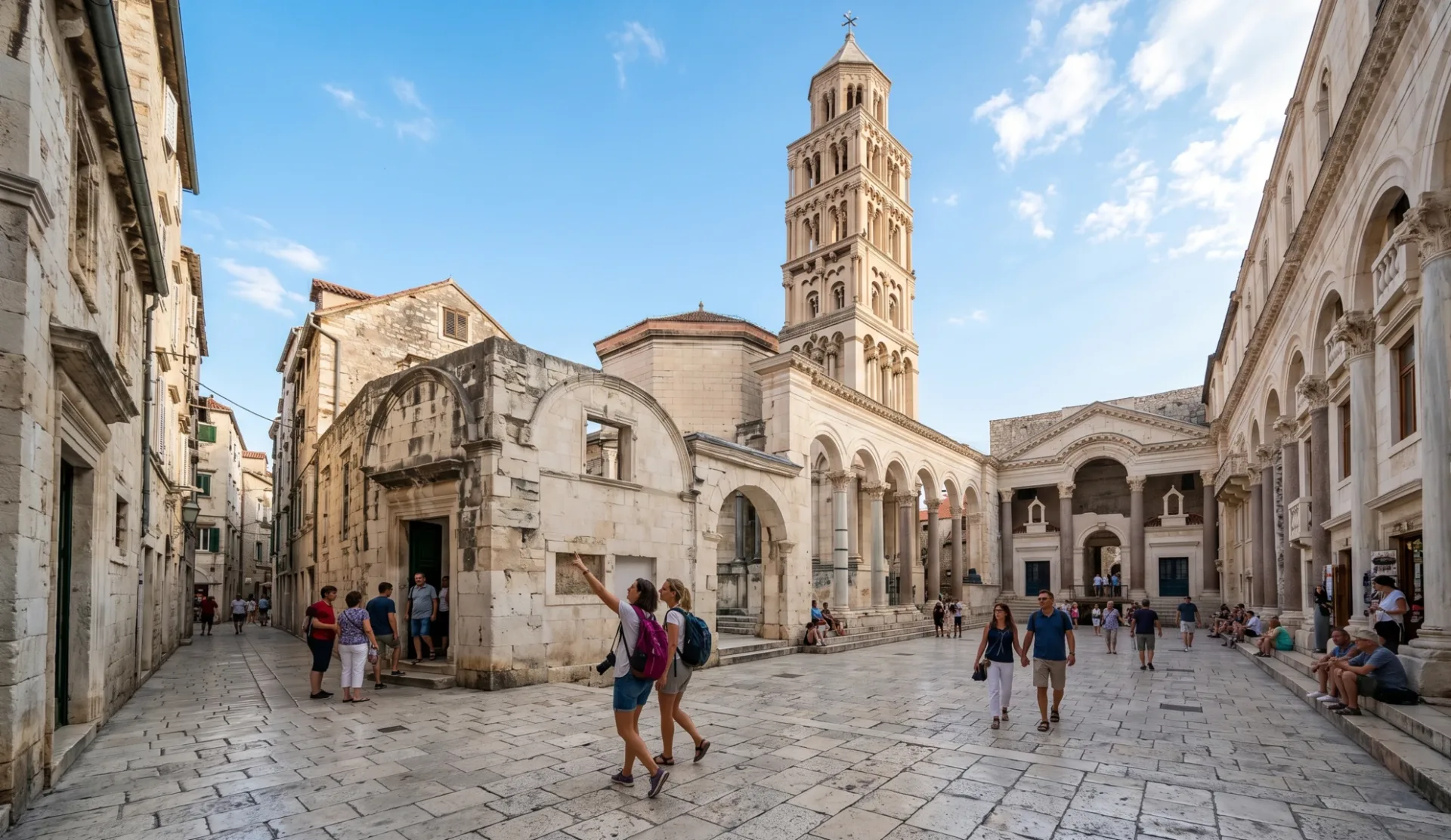
Distance: 4.5 km full loop including the Riva waterfront
Elevation gain: Under 30 m (essentially flat)
Difficulty: Easy
Duration: 1.5 to 2.5 hours self-guided; longer with stops
Trailhead: The Riva waterfront promenade, Split Old Town
The palace complex covers approximately 3 hectares and its defensive walls reach up to 28 metres in height at some points – a scale that only becomes clear when you’re standing inside it.
The logical circuit: enter through the Bronze Gate on the waterfront into the underground Podrum cellars (worth a separate ticket for 15 minutes), emerge into the Peristyle courtyard, visit the Cathedral of Saint Domnius (Diocletian’s original mausoleum, still in use as a cathedral), walk the Cardo and Decumanus – the original Roman street axes that still divide the palace – exit through the Golden Gate to see the Gregory of Nin statue, then complete the loop through Narodni Trg (People’s Square) and back to the Riva.
Best for: History enthusiasts, families with children, visitors with limited mobility, bad-weather days.
Access cost: Free to walk through the palace district; cathedral entry approximately €10; Podrum cellars approximately €6
3. Mount Mosor – Best for Serious Mountain Hikers
Mount Mosor is where the walking ends and the hiking begins. The ridge stretches from Split to Omiš along the coast and its highest point – Veliki Kabal at 1,339 m – means you’re gaining nearly 1,000 m from the city. This is part of the Via Dinarica, the long-distance trail connecting Slovenia to Albania along the entire Dinaric Alps.
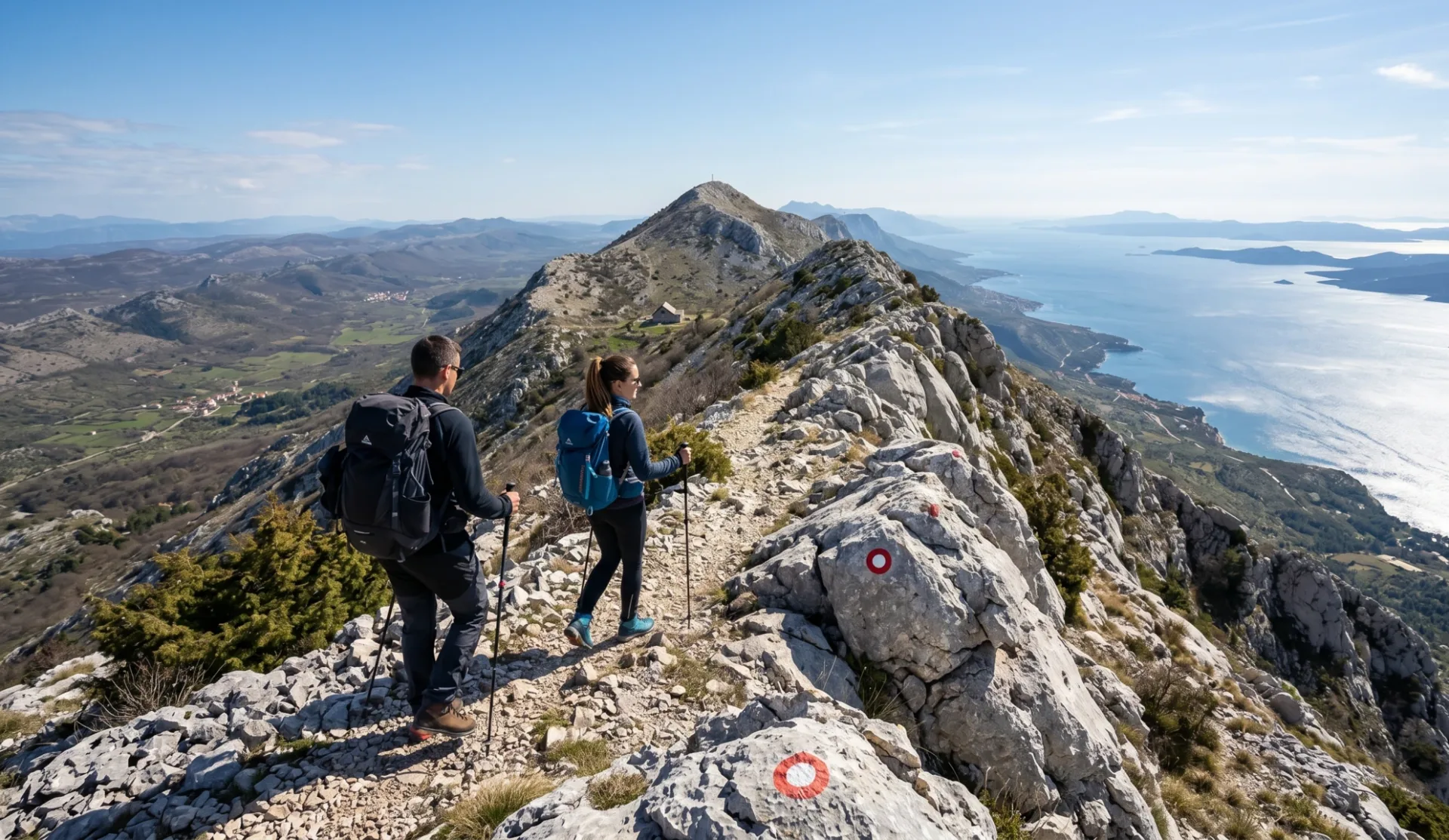
The Split-Dalmatia County trail database covers over 1,300 routes – the mountain routes around Mosor consistently rank among the most-reviewed in the region.
The trail is well-marked with red-and-white blazes throughout. There’s a mountain hut (planinarsko sklonište) near the ridge that serves hot food and is reportedly one of the busiest huts in Croatia on a clear spring weekend. The unobstructed sea view from the ridge – the Adriatic in one direction, the Dalmatian interior in the other – is unlike anything you get from Marjan Hill.
Side excursion: Vranjača Cave on the southeast slope near Dugopolje village is worth adding if you have transport.
Best for: Fit hikers with mountain experience; anyone who wants Croatia’s landscape rather than Croatia’s beaches.
Access cost: Free; mountain hut meals approximately €10–15
4. Mount Kozjak Ridge Walk – Best for Ridge Walking Without Technical Difficulty
If Mosor is too committing but Marjan feels too easy, Kozjak is the route that splits the difference. The mountain forms the northern backdrop to Split and the Kaštela Bay towns – you can see the ridge from the city centre on a clear day. Walk it and the panorama reverses: the Adriatic on your south side, Kaštela Bay on the north.
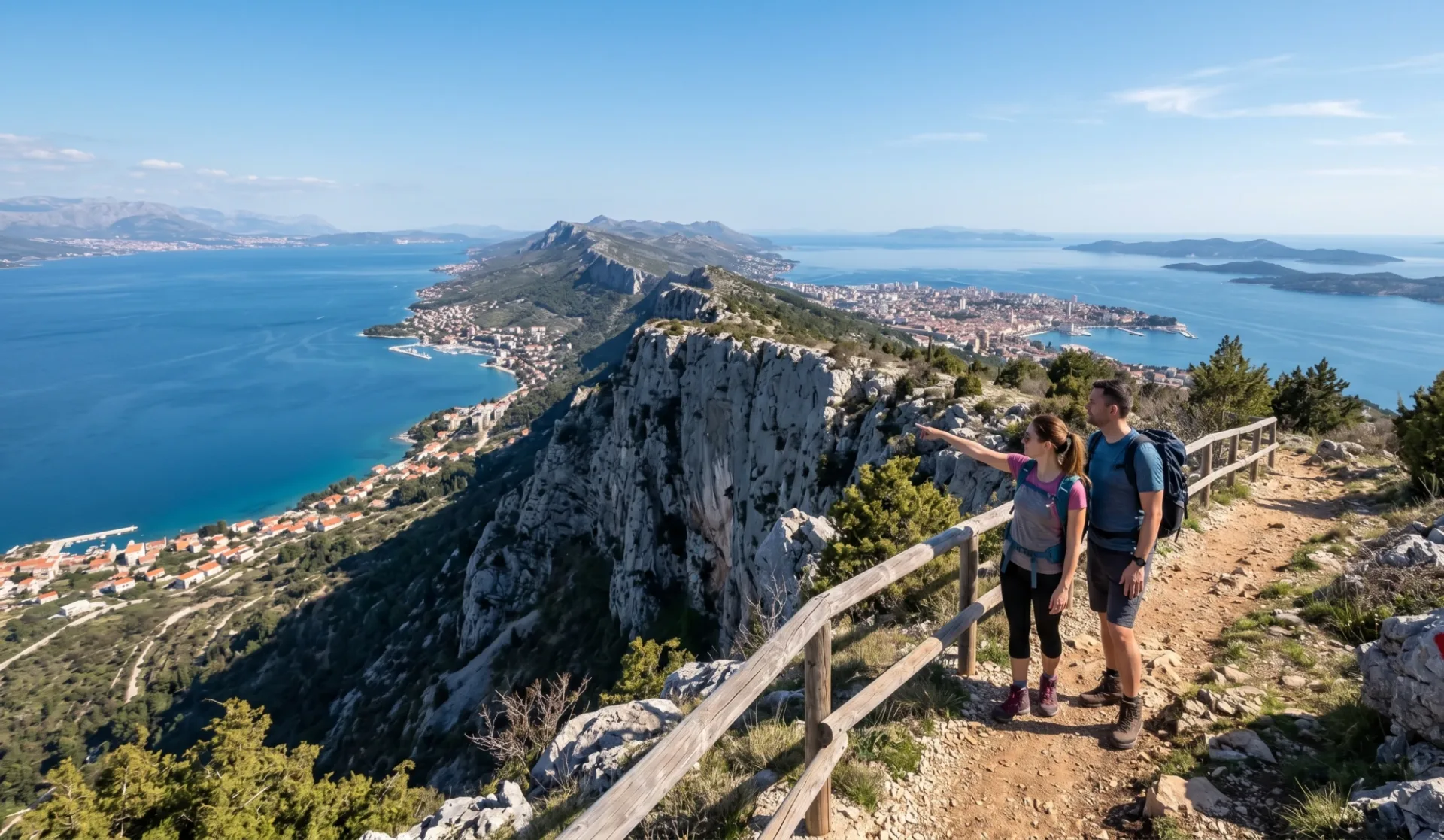
Distance: 12.2 km one way; Grand Kozjak Tour approximately 18 km
Elevation gain: 735 m (2,414 ft) on the Kaštel Sućurac – Putalj – Sv. Luka route
Highest peak: Veli Vrh at 779 m
Difficulty: Moderate
Duration: 4 to 7 hours depending on route
Best season: Spring and autumn; the exposed ridge gets very hot in summer
The mountain’s defining feature is the South Rock (Južna stijena): at 16 km long and 50–250 m high, it’s the longest continuous rock face in Croatia. The ridge trail runs above it, and on a clear spring day the visibility stretches to the islands of Čiovo, Šolta, and Brač simultaneously.
Kozjak is described as “more of a walk than a hike” on account of the consistent ridge elevation once you’ve climbed out of the valley – a fair description. Three mountain huts are spread along the route.
Best for: Hikers who want a full-day mountain experience without technical climbing; those who want overnight options.
Access cost: Free
5. COASTAL PROMENADE – Riva to Kasjuni Beach – Best for a Relaxed Evening Walk
The coastal promenade doesn’t ask anything of you. Starting from the Riva – Split’s palm-lined waterfront – and walking west along Šetalište Ivana Meštrovića takes you past the Meštrov Gallery (one of Croatia’s finest sculpture museums), the historic Kaštelet, and down to Kasjuni Beach: a sheltered pebble cove at the foot of Marjan Hill’s south slope, surrounded by pine trees, that many locals consider Split’s best urban swimming spot.
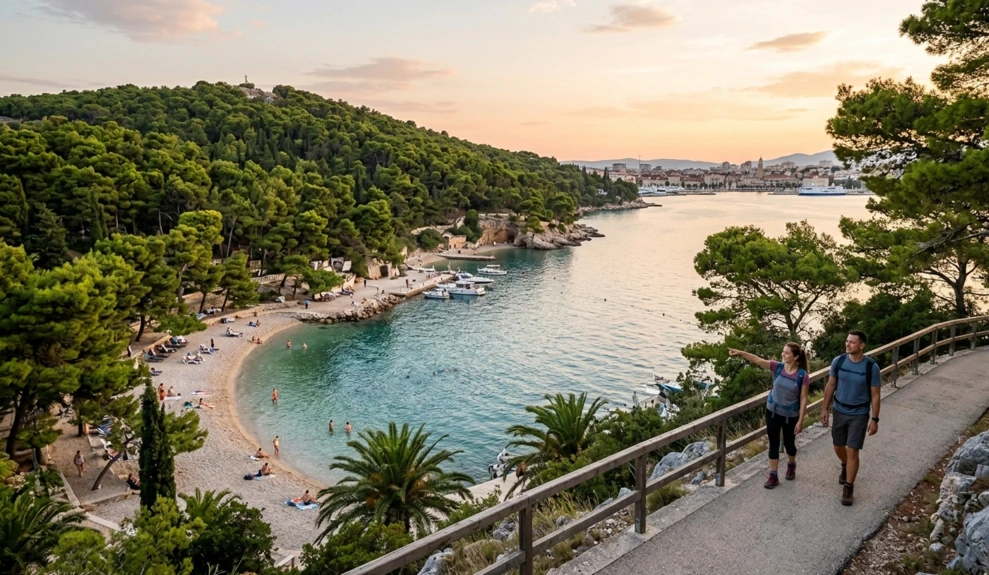
Distance: 6 km one way (12 km return)
Elevation gain: Negligible
Difficulty: Easy
Duration: 45 minutes to 1.5 hours one way
Best season: Year-round; particularly pleasant on summer evenings after 6pm when the heat drops
TRAIL COMPARISON AT A GLANCE
| Trail | Distance | Elevation | Difficulty | Duration | Best For | Cost |
|---|---|---|---|---|---|---|
| Marjan Hill Loop | 8.2 km | 190 m | Easy–Moderate | 2–2.5 hrs | Panoramic views | Free |
| Diocletian's Walk | 4.5 km | <30 m | Easy | 1.5–2.5 hrs | History & culture | Free (museums extra) |
| Mount Mosor | 12–16 km | 900+ m | Difficult | 5–7 hrs | Mountain summit | Free |
| Mount Kozjak Ridge | 12.2 km | 735 m | Moderate | 4–7 hrs | Ridge walking | Free |
| Coastal Promenade | 6 km | Flat | Easy | 45 min–1.5hr | Relaxed exploration | Free |
We selected these five routes against four criteria:
- Accessibility from the city centre – every trail is reachable by foot or local bus without a rental car
- Distinct character – each trail offers a meaningfully different experience; no two cover the same ground
- Current trail condition data – routes with documented closures or maintenance issues are flagged
- Difficulty range – the five trails collectively span from flat and easy to genuinely demanding
FREQUENTLY ASKED QUESTIONS
Marjan Hill is the standout choice for most visitors – an 8.2 km loop with 190 m of elevation gain that delivers a 360-degree panoramic view of the Adriatic islands and the Dinaric Alps from Telegrin summit at 178 m. It’s reachable on foot from the old town and takes around 2 to 2.5 hours at a relaxed pace. The Coastal Promenade is the better pick if you want something completely flat.
The coastal and urban trails (Diocletian’s Palace walk, Riva to Kasjuni promenade) are comfortable year-round. For Marjan Hill, go early morning or late afternoon to avoid midday heat. The mountain routes – Mosor and Kozjak – are not recommended in July and August; both ridges are fully exposed and heat-related incidents are common. The best hiking months for mountain routes are April–June and September–October.
No. All five trails are well-marked and require no guide for standard conditions. Mosor and Kozjak should be attempted by experienced hikers only – not because they’re technical, but because the elevation, exposure, and remoteness require solid fitness and proper footwear. For the historical walk through Diocletian’s Palace, a guided tour adds context but isn’t necessary to follow the route.
Local buses from Split city centre connect to the trailhead villages in approximately 45 minutes. Some hikers combine Mosor with a visit to the Vranjača Cave on the southeast slope near Dugopolje – check if both are feasible in a single day before setting out.
Yes. The Coastal Promenade from the Riva to Kasjuni Beach is completely flat and has no obstacles – appropriate for buggies and young children. The Diocletian’s Palace walk is similarly flat with interesting things to look at every 50 metres. The lower section of the Marjan Hill trail to the first viewpoint (Prva točka) is manageable for older children with reasonable fitness.
Where to stay in Split?


CONCLUSION
Marjan Hill’s Telegrin summit remains the strongest all-round trail in Split – the views justify the climb and it’s accessible enough that any reasonably fit visitor can do it in an afternoon. For something more demanding, the Kozjak ridge offers the mountain experience without Mosor’s full-day commitment. The Diocletian’s Palace walk and the Riva–Kasjuni promenade need no fitness at all and are worth doing regardless of what else you have planned.
Related blogs

Split Riva – what to know about the city’s most lively promenade
Split Riva is much more than just a walkway along the sea; it is the symbolic "living room" of every citizen of Split. For centuries, this promenade has been the stage for the [...]

What to do in Split on a rainy day: indoor activities and hidden spots
What to do in Split on a rainy day: discover the best indoor activities, from atmospheric cafés and local museums to wellness centres, galleries and hidden corners of the old town. Even when it rains, Split offers plenty of warm, inspiring and relaxing experiences.

Top Instagrammable Spots in Split: Capture the City Through the Lens
Split is full of stunning locations perfect for Instagram - from the ancient Diocletian's Palace to breathtaking Marjan views. This guide revelas the best photo spots around the city to help you capture unforgettable moments and share them with the world.

Hajduk Split FC: More Than Football, a Way of Life
Hajduk Split stands for more than sport - it’s a story of pride, tradition, and passion. At Poljud Stadium, matches unite generations of fans, transforming football into a shared lifestyle that celebrates community and identity across Dalmatia.